
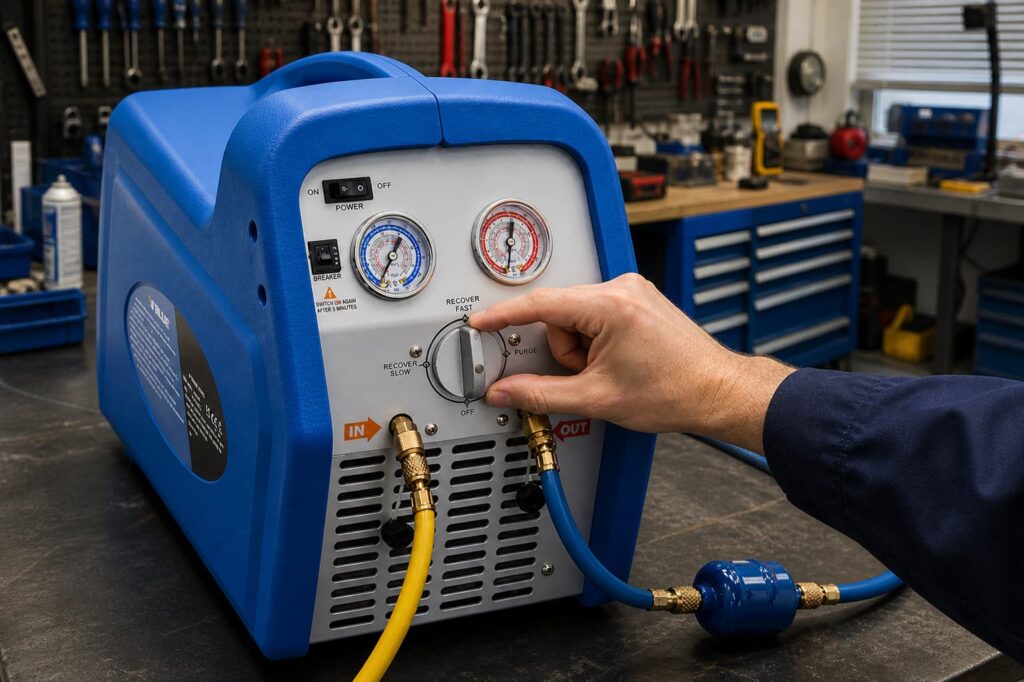
I still remember the message from a frustrated customer. He was holding a brand-new, oil-less recovery machine that had failed on its very first job. He was convinced the unit was defective. However, when our engineer opened the compressor head, the cause was undeniable: a shattered reed valve and a shredded PTFE piston seal.
The culprit? Liquid slugging. The technician had started the machine in "Recovery Fast" mode while a solid column of liquid refrigerant was still sitting in the suction line.
The good news? This kind of failure is entirely preventable. Let’s walk through why it happens, how oil-less compressors work, and the professional way to handle them.
Starting an oil-less recovery machine while the suction side is flooded with liquid creates an immediate hydraulic lock. This incompressible liquid slams into the valve plate, shattering the stainless steel reed valves and compromising the piston seals within seconds.

Many technicians treat a recovery machine like a transfer pump. It is not. It is a high-speed compressor designed to move vapor. While modern oil-less machines are marketed as "liquid-capable," they still require a controlled, metered flow. If you feed them a solid slug of liquid at 3,000 RPM, you will destroy them.
What Is Liquid Slugging and Why Does It Kill Oil-Less Units So Fast?
A sudden, sharp metallic "clanking" noise is your first and final warning. In an oil-less machine, there is no oil film to cushion the internal components, making them even more vulnerable to hydraulic shock.
Liquid slugging occurs when liquid refrigerant enters the cylinder. Since liquid cannot be compressed, the piston hits it like a hammer hitting a solid wall. This impact instantly cracks the thin stainless steel reed valves, deforms the PTFE piston seals, or even bends the connecting rod.
How an Oil-Less Compressor Works?
Most portable recovery machines use a twin-cylinder oil-less compressor. Instead of lubricated metal rings, they use high-performance PTFE (Teflon) seals and dry, hard-anodized cylinders.
On the downstroke, the suction reed valve opens, drawing in refrigerant vapor. On the upstroke, the piston compresses the vapor into a smaller space, significantly raising its pressure. When the pressure overcomes the discharge valve, the high-pressure vapor flows out.
The PTFE piston seals are crucial. They maintain a tight, dry fit against the cylinder walls. If liquid enters, it not only causes mechanical shock but also "washes" the surfaces, increasing friction. If a reed valve shatters, the metal fragments will score the cylinder walls, leading to a permanent loss of compression.
| Damage Type | Visual Sign | Immediate Effect |
|---|---|---|
| Shattered Reed Valve | Metal fragments found in the head | Zero suction/pressure; machine "hums" but won’t pull |
| Shredded PTFE Seal | Fine white or grey Teflon dust in the ports | Weak compression; machine runs but cannot reach high pressure |
| Blocked Valve Cores | Debris or copper shavings found in the ports | No flow; gauges remain static despite the pump running |
What Should You Do Before You Even Turn the Recovery Machine On?
You shouldn’t start a recovery machine against a liquid load without preparation.
Always begin by checking the system pressure and temperature. Use a Pressure-Temperature (PT) chart to determine if liquid is present. If the static pressure matches the saturation pressure for the ambient temperature, the system is full of liquid.

Reading the Signs of a "Wet" System
I always check the Saturation Point. For example, at 25°C, the static pressure of an R-410A system should be about 13.5 bar (195-200 psi) if liquid is present.
My 2-minute pre-start routine:
- Check Static Pressure: Use the PT chart to see if you are dealing with vapor or liquid.
- Use a Pressure Differential: If possible, let the system pressure naturally push into a colder recovery cylinder first. This removes some liquid without the compressor running.
- The Ice Bath Advantage: Placing the recovery cylinder in ice lowers its pressure, allowing for a safer natural flow.
How Should You Actually Run the Recovery Process?
An oil-less recovery machine has no "brain" – it will try to compress whatever you feed it.
Start the machine with the suction valve on your manifold closed. Turn the machine on first, then slowly "throttle" the valve open (open it just a little bit). Only switch to full "Liquid/Fast" mode after the system pressure has dropped and the gurgling sound of liquid is gone.
Controlling the Flow Like a Pro
- Listen: If you hear a heavy knocking or "thumping" sound, the compressor is hitting liquid. Close the valve immediately.
- Feel: The suction line should feel cool. If it starts to frost over heavily at the compressor inlet, liquid is reaching the valves. Throttle back.
How to Inspect an Oil-Less Machine After a Failure?
When a machine loses suction or fails to reach the required recovery depth, do not immediately tear it apart. A "Dead-Head" Pressure Test can help isolate the issue.
Block the discharge port with a cap or plug. Start the machine for a few seconds and watch the discharge (red) gauge. If the pressure doesn’t rise instantly, there are two likely culprits: internal component damage or a blockage.
Investigating the Loss of Pressure
If the discharge gauge doesn’t move, check the machine in this order:
- Check for Blockages (Foreign Objects): Before blaming the compressor, inspect the inlet and outlet valve cores (check valves). It is very common for copper shavings or dirt to get sucked in and clog these cores. If a valve core is blocked, the pump will run but no refrigerant can pass through.
- Check for PTFE Dust: Look inside the inlet and outlet ports for fine white or grey powder. This means the piston seals are being ground down.
- Inspect the Internal Valves: Remove the compressor head. Look for shattered stainless steel reed valves. A liquid slug often leaves a distinct circular impact mark on the valve plate.
- Search for Fragments: If a valve shatters, metal fragments go everywhere. Use a magnet and compressed air to clean the crankcase. One loose shard will destroy a new rebuild kit in seconds.

How Do You Safely Put a Machine Back into Service?
After replacing seals, valves, or cleaning out blockages, you need a Bench Test.
Build a simple test loop using a small cylinder and a manifold. Run the machine for 20 minutes. Watch the pressure and listen for any strange noises before taking it back to a real job.
Conclusion
To keep your recovery machine working for a long time, follow these simple rules:
- Don’t rush: Never feed a solid stream of liquid into the machine at full speed.
- Start slow: Always turn the machine on first, then open your manifold valves very slowly.
- Listen to the machine: If it makes a loud knocking sound, it is "choking" on liquid. Close the valve immediately.
- Check for dirt: Use filters to stop copper shavings from plugging the valve cores.
In short: Take your time and control the flow. It is much better to spend 5 extra minutes being careful than to spend $500 on a repair!


